Sixty Eight Years Ago
From rehupa.com, January 2010

REH to HPL, Dec. 1932: “Considering the Philippines – if we were allowed to fortify them, they would be a strength. As it is, they’re a weakness. Instead of being a rifle aimed at the heart of Japan ( as would be the case were they fortified and a goodly portion of our Pacific fleet stationed there), they tend to divide our forces, to scatter our lines, and to subject American citizens to danger, in case of war with Japan. I think it would be a point of strategy to abandon those islands entirely, and concentrate our forces about Hawaii. That Japan would gobble them is certain, but I scarcely think they would add much to her ultimate strength, increased as it is so enormously by her grabbing of Manchuria.”
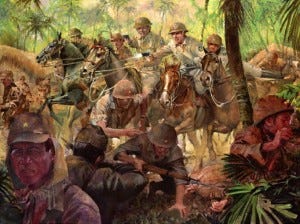
Sixty eight years ago, the First Battle of Bataan was being fought on the island of Luzon in the Philippines. The Japanese had landed in force on December 21st, 1941 after wiping out most American air power. MacArthur’s plans for fighting the Japanese on the beaches ended in a shambles when the untrained, un-equipped Philippine Army ran. Gen. Jonathan Wainwright managed one of the great retreats in history by bringing North Luzon force into the Bataan peninsula while buying time for South Luzon Force (under General Albert Jones) to escape into Bataan. One of the last horse cavalry charges in military history was performed by the 26th Cavalry during that retreat. Unfortunately, MacArthur ignored the accepted U.S. Army plan of stockpiling food and supplies when hostilities started. As it was, the Japanese got into a slug match. The American and Filipino defenders were forced to retreat to the reserve battle line but they hung on until April when disease and starvation forced their surrender. Raise a drink tonight to the 31st Infantry Regiment, the Filipino Scouts, the 59th, 60th, 200th Coast Artillery, the 192nd and 194th Tank Battalions, and the 4th Marine Regiment among others. In the end, Japanese casualties were close to 30,000 killed, wounded, and diseased. Those 30,000 could have tipped the scales in New Guinea or Guadalcanal later in 1942. Sixty-eight years ago today was the beginning of one of the great last stands in history.